
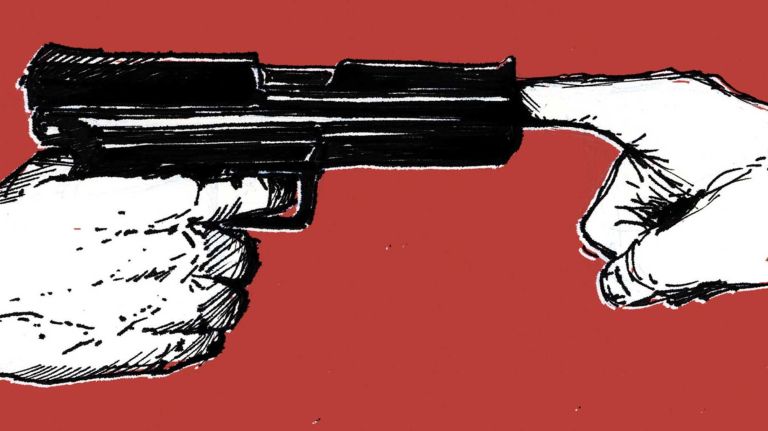
The Second Amendment was intended to protect the right of militias to own guns, not the right of individuals. Former Justice John Paul Stevens, JD, in his dissenting opinion for District of Columbia et al. v. Heller, wrote, "the Framer's single-minded focus in crafting the constitutional guarantee 'to keep and bear arms' was on military use of firearms, which they viewed in the context of service in state militias," hence the inclusion of the phrase "well regulated militia." Michael Waldman, JD, President of the Brennan Center for Justice at the New York University School of Law, stated there is nothing about an individual right to bear arms in the notes about the Second Amendment when it was being drafted, discussed, or ratified; the US Supreme Court declined to rule in favor of the individual right four times between 1876 and 1939; and all law articles on the Second Amendment from 1888 to 1959 stated that an individual right was not guaranteed.
The presence of a gun makes a conflict more likely to become violent. The FBI found that in 2013 arguments (such as romantic triangles, brawls fueled by alcohol or drugs, and arguments over money) resulted in 1,962 gun deaths (59.9% of the total). A June 1985 study published in the American Journal of Public Health found that "the weapons used [in altercations]… were those closest at hand." [38] An editorial published in the June 1985 American Journal of Public Health noted, "gun-inflicted deaths [often] ensue from impromptu arguments and fights; in the US, two-thirds of the 7,900 deaths in 1981 involving arguments and brawls were caused by guns."A 1993 study published in The New England Journal of Medicine found that "rather than confer protection, guns kept in the home are associated with an increase in the risk of homicide by a family member or intimate acquaintance."